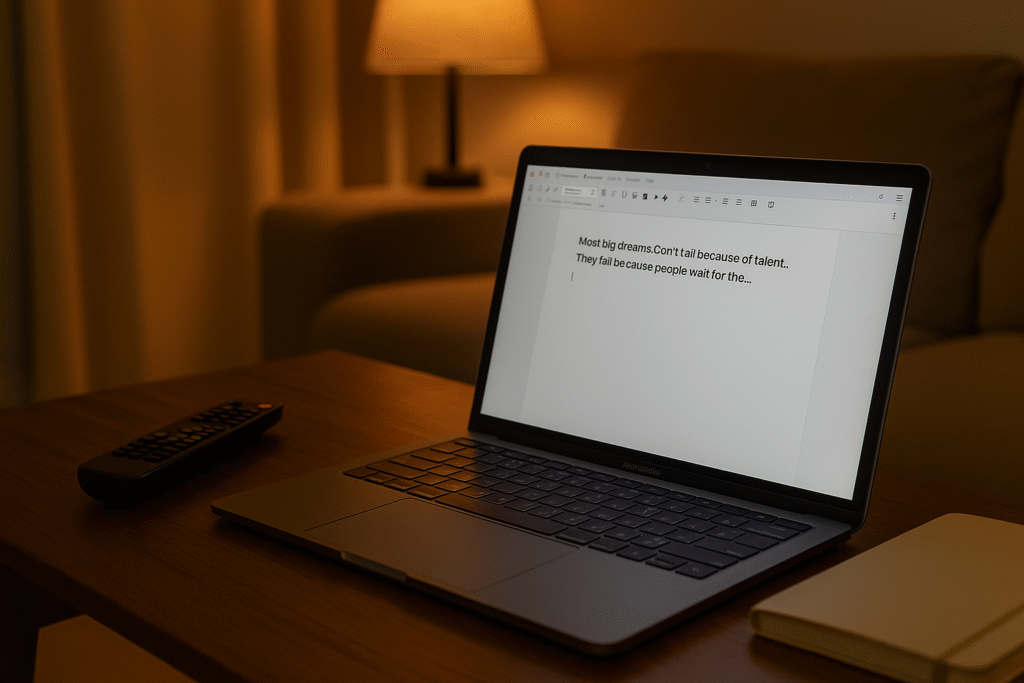
Most big dreams don’t fail because of talent. They fail because people wait for the perfect time - the big weekend, the long holiday, the golden stretch of free hours. That time rarely comes. Progress doesn’t need marathons. It needs trade-offs.
Eric’s novel came from one trade-off. He swapped three Netflix nights a week for 300 words. That’s it. No retreat, no giant leap. Just a consistent choice that stacked up over time.
Why big dreams stall
We picture massive progress: writing for eight hours straight, running for two hours a day, building a business in a sprint. That fantasy keeps us waiting until life is perfect. But perfect never comes. Reality is full of work, kids, emails, and fatigue.
Dreams fade not because people lack passion, but because they lack structure.
The Netflix trade-off
Eric loved Netflix. Most nights he streamed for hours. When we looked for space to write, the answer was obvious: trade streaming for writing. Not every night - just three. The rule was clear:
“Write 300–400 words before bed, three nights a week.”
Small. Repeatable. Doable even on tired days.
Why 300 words work
• Low friction. 300 words take 20–30 minutes. That’s easier than “write a chapter.”
• Momentum. Words pile up. 300 becomes 600. 600 becomes 1,200. Progress compounds.
• Psychology. Small daily wins fuel motivation instead of draining it.
• Math. 300 words × 3 nights × 50 weeks = 45,000 words. That’s a short novel.
Small doesn’t mean weak. Small means sustainable.
What changed for Eric
Within two weeks, he had 6,000 words. For the first time, the book felt real. He stopped feeling guilty about “never starting.” He had proof of progress. And progress created energy.
After six months, he had half a manuscript. Not from inspiration. From subtraction. From removing three Netflix nights and swapping them for words.
Why this works
Success comes from subtraction before addition. You don’t need to find more time. You need to stop wasting the time you already have. Replace one low-value habit with one high-value habit. The swap compounds. That’s the secret.
Eric didn’t get more hours. He traded hours. And that trade built a book.
How to do your own trade-off
Step 1 - Spot the leak.
Find a low-value recurring activity. Scrolling, streaming, gossip, late-night email. Be honest.
Step 2 - Pick 2–3 slots a week.
Not every day. Just enough to create momentum without collapse.
Step 3 - Make a small promise.
300 words. 20 minutes. 1 call. Specific and measurable.
Step 4 - Track for four weeks.
If it sticks, keep going. If it doesn’t, shrink the promise until it does.
What this means for you
You don’t need to overhaul your life. You need one smart trade-off. Subtract something low-value. Add something that builds your future. Do it three times a week. Let compounding do the rest.
That’s why in the 4P Clarity Method we always ask: “What will you trade to make space for this?” Without the trade, the goal is just a wish. With it, progress is inevitable.
Three Netflix nights for 300 words. That’s how books get written.
Want a personalized clarity system?
If this resonates, don’t stop here. You can have a tailored blueprint built around your exact goals, challenges, and energy patterns.
👉 See the full 4P Clarity Method here:
https://coachraido.com/4p-clarity-method/